Picking a takeout container looks simple until you are standing in front of a dozen formats, each in five sizes, and none of the labels tell you which one holds a burrito bowl versus a side of slaw. The formats are not interchangeable: a round deli cup, a hinged clamshell, and a three-compartment tray are built for different jobs, and matching the format to the food before you argue about price will save you from ordering a pallet of boxes that do not close over your portions. This is a format-by-format comparison of what each style holds, what it fits, and where the practical lines fall.
Match the format to the food, not the other way around
Two variables decide almost everything: how much the food weighs or measures, and whether it is served hot, cold, saucy, or dry. Capacity is quoted in fluid ounces, and it is worth measuring a real portion of your actual menu item with a measuring cup rather than guessing, because a “16-ounce” salad and a “16-ounce” stew fill a container very differently once you account for headspace and a lid that has to seat. The other half is heat: polypropylene formats tolerate reheating and hold up to hot food, while the crystal-clear PET styles are meant for cold applications and can warp under heat. Format and material travel together, so decide both at once.
Round deli containers: the workhorse in five sizes
The round deli container is the most flexible format in the category, most commonly stocked in 8, 12, 16, 24, and 32 ounce sizes that all share one lid diameter per line, which is the whole point: one lid fits the stack, so a kitchen carries a single lid SKU instead of five. The small end, 8 to 16 ounces at roughly 4 to 5 inches across, handles sides, side salads, dressings you do not want to leak, and small desserts. The 24 and 32 ounce sizes cross into single-entree territory for soups, grain bowls, and pasta. Their round shape stacks and seals well and survives the cooler, which is why prep kitchens and delis default to them. The chart below lays out the capacity span of each format so you can see where deli cups overlap with the boxes.
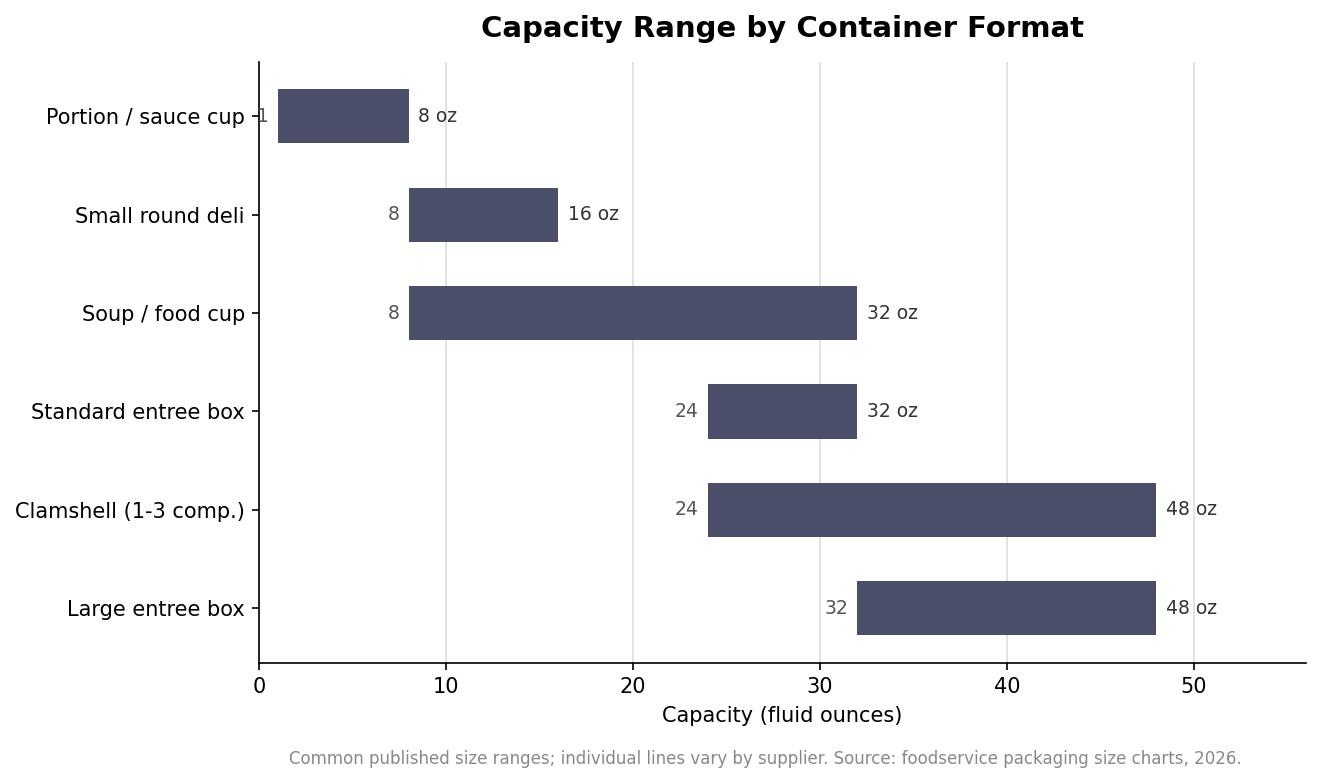
The trade-off is shape. A round cup is efficient for anything scoopable but wastes space around a rectangular sandwich or a plated entree, which is where the flat formats earn their place.
Clamshells and compartment trays: entrees with sides
Hinged clamshell containers are the format for a plate of food that should not turn into a mixed pile in transit. Common footprints run from about 8 by 8 inches to 9 by 9 inches, holding roughly 24 to 48 ounces, and they come with one to three compartments. The single-compartment version suits a sandwich and chips or a slice of cake; the three-compartment tray keeps an entree, a starch, and a vegetable in their own lanes so sauces do not migrate. Because the lid is attached and hinged, there is no separate lid to lose or mismatch, and the flat bottom carries a full combo plate the way a round cup cannot. The limitation is sealing: a hinge tab is not as leak-resistant as a snap-on deli lid, so clamshells are a poor choice for brothy or very saucy dishes that a deli cup would contain better. Clamshells are also the format most often specified in molded fiber for operators who want a compostable, uncoated option, so if sustainability is on your checklist this is usually where that decision gets made.
Portion cups and soup containers: the specialists
At the small end sit portion and sauce cups, roughly 1 to 8 ounces and 3 to 4 inches across, built for dressings, dips, and small extras rather than a meal. They are cheap by the sleeve and easy to over- or under-order, so estimate them per entree, not as a round number. Soup and food cups overlap the deli range but are shaped and lidded for liquids, typically spanning 8 to 32 ounces with a tight-seating lid and often a vented option for hot fills. If your menu leans on soups, chilis, or saucy sides, treating these as their own line rather than forcing a deli cup to do the job will cut leak complaints noticeably.
Reading capacity against footprint before you commit
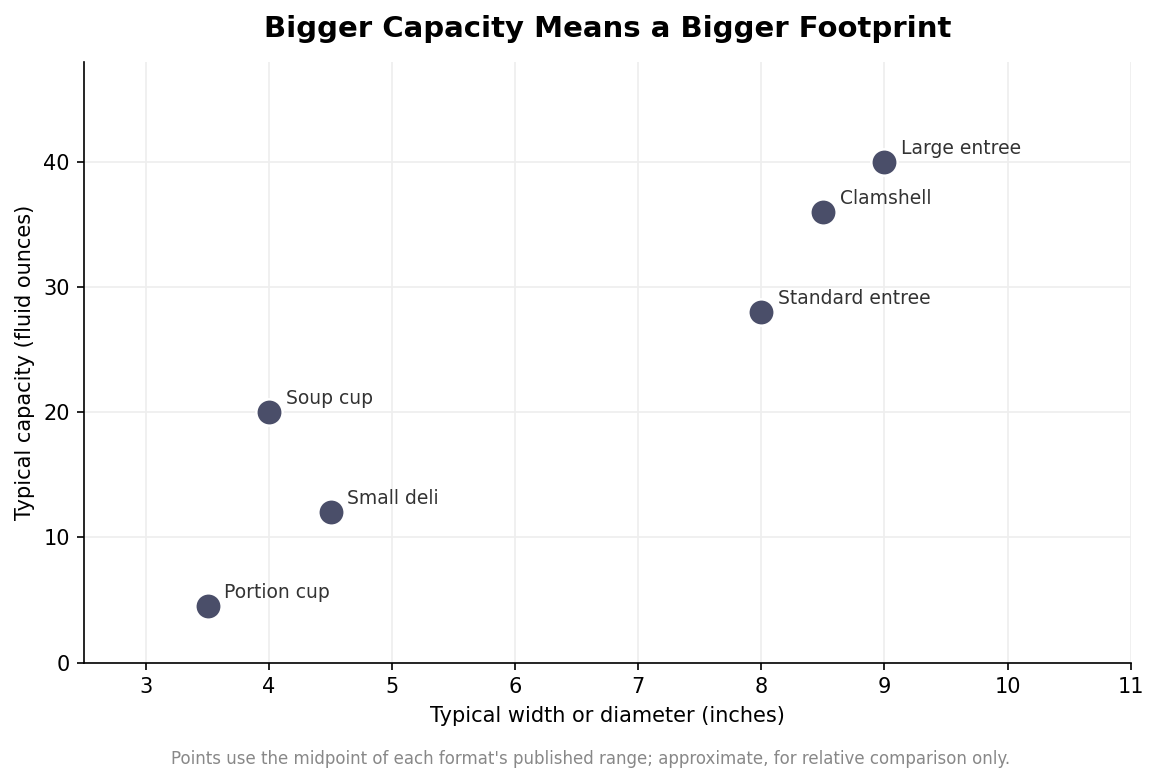
The last comparison is physical: capacity and footprint rise together, and a bigger number on the label means a bigger box on the shelf, in the bag, and in your storage. Plotting typical capacity against width makes the relationship plain, and it is the reason a 48-ounce clamshell that looks generous also eats three times the shelf space of a small deli cup.
Put the pieces together in this order and the choice gets easy. Measure a real portion of the dish, decide hot or cold so the material is set, pick the format whose shape suits the food, round or flat, single or compartmented, and only then choose the size that clears your portion with a little headspace. Confirm the lid situation, one universal deli lid versus an attached hinge, because that quietly drives both your SKU count and your leak rate. Get those four decisions right and the container fits the food, closes on the first try, and stacks in the cooler without a fight, which is all any kitchen actually wants from its packaging.