We quote the lid. That is most of what goes wrong here.
Customized Food Containers makes rigid round deli pots, rectangular meal-prep builds, hot-fill soup containers, freezer and batch-prep builds, reusable and returnable programmes and multi-site foodservice lines — base and lid always quoted as a pair.
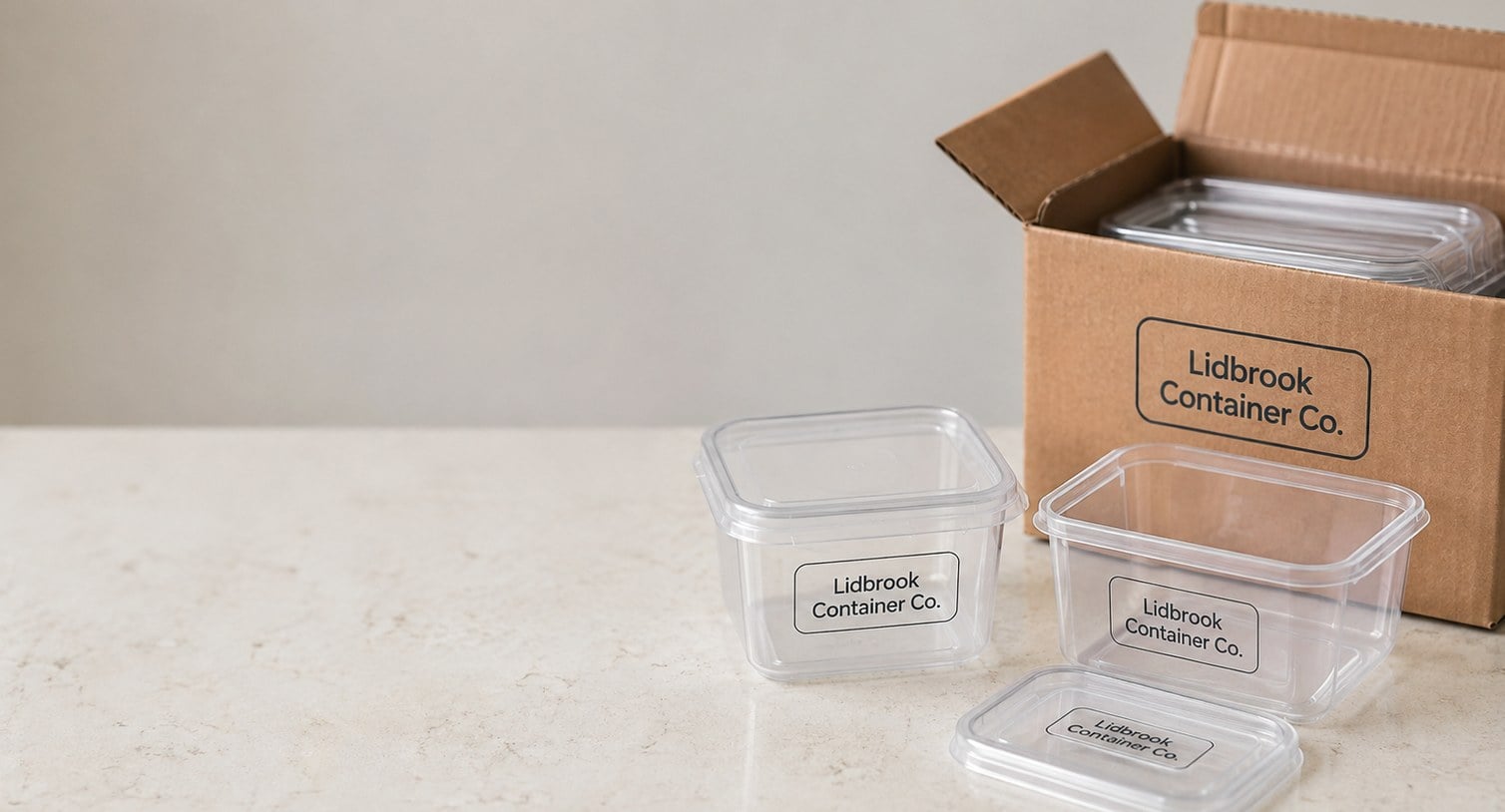
A food container is not one product. It is a base and a lid: two part numbers, two tools, two lead times.
Which is why the most common failure in this category has nothing to do with the container — it is a storeroom full of bases and no lids on the busiest Saturday of the quarter.
After the pairing, two numbers decide everything else: how tightly the empties nest, and how much load a full one carries.
Why we exist
Containers are ordered by the case and specified by picture, and the two things that actually cost money are never quoted: the pairing and the nesting.
Both are settled long before a case arrives, and neither is difficult.
Base and lid, one line
Separate part numbers with separate lead times drift apart the moment somebody reorders in a hurry.
We quote them as a pair, pack them as a pair and hold the pairing on your account, so a reorder cannot get out of step.
A lookalike lid usually is not one
Sealing rims differ by fractions of a millimetre between tools.
A nearly-fitting lid is worse than an obviously wrong one, because it fails in a delivery bag rather than on the bench.
Nest ratio and stack load
Nest ratio decides how much shelf your empty stock occupies every single day.
Stack load decides what a bag with four meals in it looks like on arrival. Both are real specifications; almost nobody quotes them.
Hot, cold, and the words in between
Microwave-safe and oven-safe are different properties and are blurred constantly. We state them separately, per material.
Freezing embrittles plastics, so freezer builds are chosen for low-temperature toughness rather than thickness — a lid that clips warm can crack at minus eighteen.
Reusables are a loop, not a product
Who washes them, where they return to, what the deposit is, and what happens to the ones that never come back.
Answer those four and the container is straightforward. Skip them and no container will save the scheme — we will ask before quoting.
What we say about recycling
Whether a container is actually recycled depends on your local collection stream, not on the resin.
So we tell you exactly what the material is and let you check what your own contractor accepts. Any flat ‘yes’ is overstating it.
What we will talk you out of
Three compartments when two would do. A domestic-rated container in a commercial wash. Mixing lid suppliers. Even stock splits across a group. And folded boxes, clamshells, trays or cups — none of which we make.
Each refusal costs an order occasionally and costs trust never.
How we work
ASK
Your sizes, how they are filled, and how they are reheated.
RATIONALISE
The fewest sizes that cover the menu, sharing lids.
SPEC
Pairing, nest ratio, stack load and reheat ratings.
MOCK
Free mockup within 24 hours, base and lid together.
SHIP
About 2 weeks, paired in the case and split by usage.
Who we serve
Get in touch
Text or call George at (929) 605-4397, or email info@customizedfoodcontainers.com. Free mockups, low minimums, and a lowest-price guarantee.
Win Free Stuff
Enter below for a chance to win plus receive 10% off your first order.
🎉 You are in!
We will text you your 10% off code. Good luck!