Choose round deli food containers for soups, sauces and sides, and rectangular meal-prep food containers for complete plated meals that need compartments and edge-to-edge packing. Customized Food Containers prints both shapes with your logo from a minimum order of 12, so this guide compares leaks, storage, presentation and branding to help you pick the right one first.
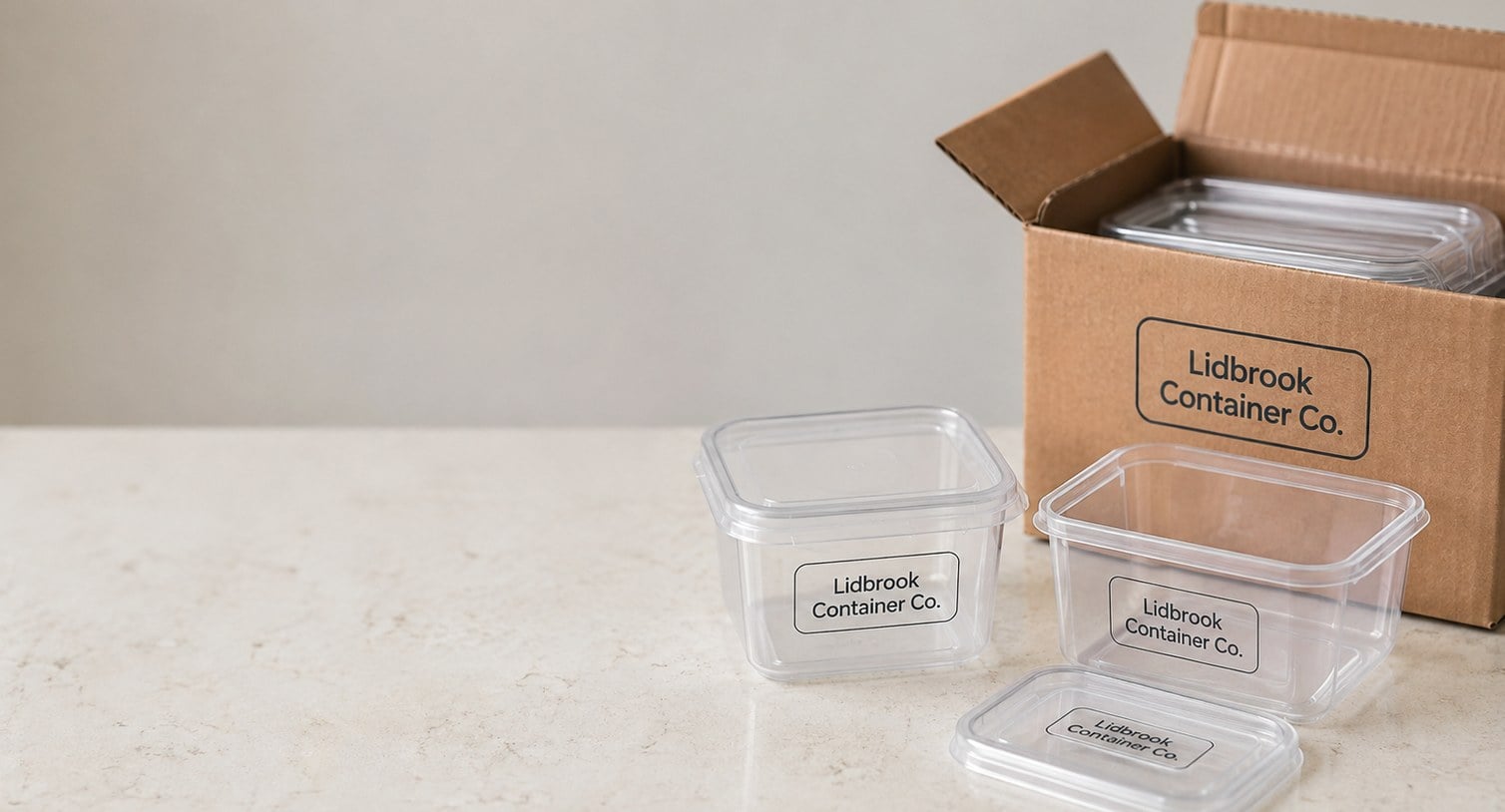
- Round deli containers seal evenly with no corners, ideal for liquids and sides
- Rectangular meal-prep containers offer compartments and pack edge to edge
- Both shapes start at a minimum order of 12 with the lid quoted together
- Free mockup within 24 hours; standard turnaround about 2 weeks after approval
Round deli containers vs rectangular meal-prep containers: what is the actual difference?
Round deli containers and rectangular meal-prep containers solve different packing problems, even though both are rigid, lidded food containers that can carry your logo. A round deli container is a tub: a single open cavity with a press-on lid, built for food that pours, spoons or settles. A rectangular meal-prep container is a tray: a flatter footprint, often with one or more compartments, built for a plated meal that should arrive looking the way it left the kitchen.
That shape difference drives everything else on this page. Round tubs seal evenly all the way around, so they are forgiving with liquids and sauces. Rectangular trays use space more efficiently in a fridge, a delivery bag or a display case, and they hold separated components without mixing. Neither format is better in general. The right choice depends on what you put inside, how it travels and where the customer opens it.
Customized Food Containers prints both formats, and both start from the same minimum order of 12 with a free mockup within 24 hours, so the decision can be made on fit rather than on ordering rules. Browse the round deli and portion containers and the rectangular meal-prep containers to see the styles side by side.
Which food containers are better for soups, sauces and sides?
Round deli containers are usually the better choice for soups, stews, sauces, dressings, dips and loose sides. A circular rim has no corners, so a press-on lid applies even pressure all the way around and there is no weak point where liquid tends to escape. Round walls are also easy to scrape clean with a spoon, which customers notice when they get to the last of a chili or curry.
Rectangular meal-prep containers can carry wet food, but corners are where sauce pools and where lids are hardest to seat perfectly. If a dish is mostly liquid, a rectangle adds risk without adding anything the customer values.
Round portion tubs also cover the small jobs a kitchen does all day: a side of slaw, a cup of rice, extra dressing, a dessert portion. Because one diameter often accepts several depths with the same lid, a kitchen can run a family of sizes without multiplying lid stock. For hot liquids specifically, the soup and hot-fill containers page covers the formats built for that job.
Which food containers work best for complete plated meals?
Rectangular meal-prep containers are the stronger choice for complete meals: a protein, a starch and a vegetable that should stay separate and look intentional when the lid comes off. The flat, wide base lets food sit in a single layer instead of stacking, and compartment versions keep a sauce from soaking into rice or greens before the customer is ready.
This matters most for businesses that sell the meal as a product rather than as takeout:
- Weekly meal-prep services that deliver several days of lunches at once and want every tray to look consistent in the customer’s fridge.
- Gyms, cafes and grab-and-go fridges where a clear lid turns the food itself into the display.
- Corporate lunch drops where each person gets one complete meal, labeled and ready to eat at a desk.
A round tub can hold a grain bowl, but layered bowls tend to shift in transit and the components blend. When presentation is part of what you are selling, the rectangle protects it.
How do the two shapes compare side by side?
The quickest way to choose between round deli containers and rectangular meal-prep containers is to score them against the jobs your kitchen actually does. The table below summarizes how each format behaves in practice.
| Factor | Round deli containers | Rectangular meal-prep containers |
|---|---|---|
| Best foods | Soups, sauces, dips, sides, desserts | Plated meals, bowls with separate components, salads |
| Leak behavior | Even seal with no corners | Corners need a well-seated lid |
| Compartments | Single cavity | Single or multi-compartment |
| Fridge and bag space | Leaves gaps between tubs | Packs edge to edge |
| Display appeal | Good for stacked sides | Strong for full meals under a clear lid |
| Lid sharing | One lid often fits several depths | Lids usually matched to each tray |
| Logo area | Lid top and wrap-around side | Wide flat lid and long side walls |
Most kitchens find that one column clearly wins for their main product, and the other column covers a supporting role.
Where does a logo show best on each container shape?
Branding works differently on round and rectangular food containers, and it is worth planning the artwork around the shape before you request a mockup. On a round deli container, the lid top is a circle, so a centered logo or round badge reads naturally. The side wall wraps continuously, which suits a repeating pattern or a band of text that a customer sees from any angle on a shelf.
A rectangular meal-prep container offers a wide, flat lid that behaves more like a label. That surface has room for a logo plus a short line, such as a menu name, a reheating note or a website. The long side walls are useful when trays are stacked in a fridge and only the edge is visible.
Customized Food Containers returns a free mockup within 24 hours showing your artwork on the exact format you choose, with unlimited free revisions. You pay nothing until you approve the design, so it costs nothing to compare a round and a rectangular layout before committing. The how it works page walks through the proof step.
How do storage, stacking and delivery change the decision?
Rectangular meal-prep containers usually win on space, and round deli containers usually win on flexibility. Rectangles sit flush against each other, so a delivery bag, a walk-in shelf or a customer’s fridge holds more meals with less wasted room. Round tubs leave small gaps between them, which matters less for a few sides and more for a whole week of meals.
Round tubs make up for that with simple inventory. Kitchens that run several portion sizes on one lid diameter carry fewer lid types, and the empties nest neatly on the line. For operators who prep ahead and freeze, both shapes can work; the freezer and batch-prep containers page explains which styles are suited to cold storage.
Think through the full path the food container takes:
- Where it is filled and lidded on the line.
- How it is stored before pickup or delivery.
- How it rides in the bag or vehicle.
- Where the customer opens, reheats or stores leftovers.
Whichever shape survives every step with the least fuss is the right one for your main menu item.
Should a restaurant order both shapes in one custom run?
Many food businesses end up ordering both round deli containers and rectangular meal-prep containers, because most menus mix entrees with sides, soups and sauces. A restaurant might send mains in branded rectangles and every side, dressing and dessert in branded round tubs, so the whole order looks like one family when it is unpacked.
Ordering both formats from Customized Food Containers keeps the branding consistent: the same logo file, the same colors and one proof process across shapes. Each format still needs to reach the minimum order of 12, so even a small operation can test a matched set without stocking a warehouse.
A practical way to start is to choose the format that carries your best-selling item first, then add the second shape once you have seen how the first performs in real service. Groups running several locations can read about coordinated ordering on the multi-site and foodservice programmes page.
What should you check before ordering custom round or rectangular food containers?
Before you order custom food containers in either shape, confirm a few practical details with your own menu in hand. Bring a sample of your heaviest, saucier and largest dishes to the decision rather than choosing from photos alone.
- Portion fit: the food should fill the container without pressing against the lid or rattling around.
- Heat path: note whether the dish is packed hot, chilled, frozen or reheated by the customer, and ask which styles suit that path.
- Lid matching: Customized Food Containers quotes the base and lid together, so confirm the exact pairing for each shape you order.
- Artwork placement: decide whether the lid, the side or both carry the logo.
- Timing: standard turnaround is about 2 weeks after design approval, with faster turnaround available through express shipping.
When those answers are clear, the custom quote form takes a few minutes, and a mockup of your chosen shape comes back within 24 hours.
Frequently asked questions
Are round deli food containers or rectangular meal-prep food containers better for a soup restaurant?
Round deli food containers are the better fit for a soup restaurant because the circular rim has no corners, so a press-on lid seals evenly and liquid has fewer places to escape. Rectangular trays suit plated meals more than broths. Many soup shops still add a small rectangular line for sandwiches or salads, and Customized Food Containers can brand both shapes with the same artwork.
Can rectangular meal-prep food containers keep sauces separate from the main dish?
Rectangular meal-prep food containers are available in compartment styles that keep a sauce, a starch and a protein apart until the customer is ready to eat. That separation stops rice or greens from going soggy during delivery. For very wet sauces, many kitchens pack the sauce in a small round portion tub and nest it inside the tray instead of pouring it in.
Do round deli food containers take up more fridge space than rectangular ones?
Round deli food containers leave small gaps between each tub, so a shelf or delivery bag usually holds fewer of them than flush-packing rectangular trays. The difference is minor for a handful of sides and noticeable for a full week of meals. Customers storing several meals at home often prefer rectangles for that reason, while kitchens value round tubs for shared lids.
Can I print a different design on round and rectangular food containers in the same order?
Food containers in different shapes can carry different layouts in one order, such as a round badge on deli lids and a wider logo with a menu line on meal-prep lids. Customized Food Containers prepares a free mockup within 24 hours for each format, with unlimited free revisions, and you pay nothing until every design is approved.
Which food container shape looks best in a grab-and-go fridge?
Rectangular meal-prep food containers usually look best in a grab-and-go fridge because a clear lid shows the whole meal laid out flat, which helps shoppers choose quickly. Round deli tubs work well beside them for sides, fruit or desserts stacked in neat columns. A branded lid on both shapes makes the fridge read as one consistent range.
Is the minimum order the same for round and rectangular custom food containers?
Custom food containers from Customized Food Containers start at a minimum order of 12 for each format, whether you choose round deli tubs or rectangular meal-prep trays. That low starting point lets a small cafe or a new meal-prep brand test a shape in real service before committing to larger runs. Each style is quoted with its matching lid included.
Can one lid fit several sizes of round deli food containers?
Round deli food containers are often made in families where several depths share one lid diameter, so a kitchen can carry fewer lid types while offering different portion sizes. Confirm the exact pairing on your quote, because not every style follows that pattern. Rectangular meal-prep trays usually need a lid matched to each specific tray rather than one shared size.
Which food container shape is easier for customers to eat from at a desk?
Rectangular meal-prep food containers are usually easier to eat from at a desk because the flat, wide base works like a plate and the food stays in one layer. Round deli tubs suit soups, salads and bowls eaten with a spoon or fork held close. For corporate lunch drops, a branded rectangle for the main and a small round tub for the side is a common pairing.
How long does it take to receive custom round or rectangular food containers?
Custom round and rectangular food containers follow the same schedule at Customized Food Containers: a free mockup within 24 hours of your request, then standard turnaround of about 2 weeks after you approve the design. Faster turnaround is available with express shipping. Ordering two shapes together does not add a separate approval process if the artwork is shared.
Should a new meal-prep business start with round or rectangular food containers?
A new meal-prep business usually starts with rectangular food containers because complete plated meals are the core product and the flat tray protects presentation through delivery and refrigeration. Round deli tubs become useful once you add sauces, snacks or extra sides. Starting with one shape at the minimum of 12 keeps early stock simple while you learn what customers reorder.
Can I order a mockup of both food container shapes before choosing one?
Food containers in both shapes can be mocked up before you decide, so you can see your logo on a round lid and a rectangular lid side by side. Customized Food Containers returns each mockup within 24 hours at no charge, revisions are unlimited, and nothing is paid until you approve. Comparing real layouts often settles the shape question faster than comparing catalog photos.
Get a free mockup for your food containers
Send your logo or idea and the quantity you have in mind. Customized Food Containers returns a free mockup within 24 hours, you approve the design before anything is produced, and standard turnaround is about two weeks with faster options available. Get a custom quote.